Royaltop, as an expert in the production of plastic products, let me explain to you the commonly used plastic packaging materials. There are different types of plastics, and different types of plastics have different levels of safety. At the bottom of plastic mineral water bottles, and plastic spice jars you will often see a triangular symbol, like the picture below: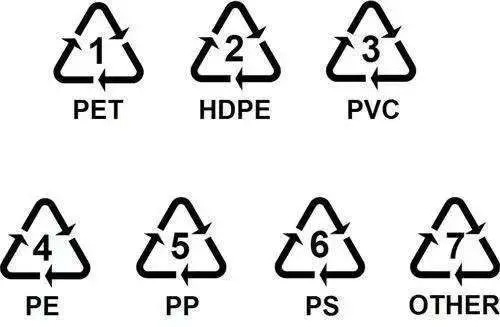
According to popular parlance, this symbol is the American Society of the Plastics Industry has developed a marking code for the type of plastic used in plastic products, which is a triangle made up of three arrows representing the cycle, with a numerical sign in the middle, mainly used to facilitate the labeling of the post-recycling. Through these numbers we can quickly know the type of plastic.
01 PET Polyethylene terephthalate
Common uses: mineral water bottles, carbonated beverage bottles, etc.
Mineral water bottles and carbonated beverage bottles are made of this material, including our spice bottles, which are also made of PET. Beverage bottles can not be recycled to fill hot water, this material is heat resistant to 70 ℃, only suitable for warm or frozen drinks, loaded with high-temperature liquids or heating is easy to deform, there are harmful substances dissolved. And, scientists have found that the repeated use of such plastic products for a long time, such as as reusable water bottles, may release carcinogens, toxic to humans. Therefore, beverage bottles and other used up on the throw away, do not use as a water cup, or used to do storage containers to hold other items, so as not to cause health problems more than worth it.
PET was initially used for synthetic fibers, negatives, tapes, etc., and was used for beverage bottles only in 1976. PET is used as a raw material for filling containers, which are commonly known as "PET bottles". PET bottles have excellent hardness, toughness, light weight (only 1/9 ~ 1/15 of the weight of glass bottles), easy to carry and use, less energy consumption during production, plus airtight, non-volatile, acid and alkaline resistant, it is a good packaging material for carbonated beverages. In recent years, it has become an important filling container for carbonated beverages, tea, fruit juice, packaged drinking water, wine and soy sauce, etc. In addition, such as detergents, shampoos, food oils, condiments, sweet foods, medicines, cosmetics, and alcoholic beverages have been used in large quantities in the packaging bottles of PET bottles.
02 HDPE High Density Polyethylene
Common uses: Cleaning products, bath products, etc.
Plastic containers for cleaning and bathing products, most of the plastic bags used in supermarkets and shopping malls are made of this material, which can withstand high temperatures up to 110°C. Plastic bags labeled for food can be used to contain food. Plastic containers for cleaning products, bath products can be reused after careful cleaning, but these containers are usually not good for cleaning, residue of the original cleaning products, into a breeding ground for bacteria, cleaning is not complete, it is best not to recycle.
03 PVC Polyvinyl chloride
Common use: raincoats, building materials, etc.
According to the introduction, this material of plastic products easy to produce toxic and harmful substances from two aspects, one is not fully polymerized monomolecular vinyl chloride in the production process, the second is the plasticizer in the harmful substances. These two substances are easy to precipitate when encountering high temperatures and grease, toxic substances with food into the human body, easy to cause cancer. At present, containers of this material have been used relatively rarely for packaging food. If it is in use, never let it be subjected to heat.
04 LDPE Low-density polyethylene
Common uses: Cling film, etc.
Cling film, plastic film, etc. are made of this material. Heat resistance is not strong. Usually, qualified PE cling film will melt when the temperature exceeds 110°C, leaving some plastic agents that the human body cannot decompose. And, wrapped in plastic wrap food heating, food oils and fats in the food is easy to dissolve the harmful substances in the plastic wrap. Therefore, food into the microwave oven, the first to remove the wrapped plastic wrap.
05 PP Polypropylene
Common use: microwave oven lunch box
Microwave oven lunch box made of this material, 130 ℃ high temperature resistance, poor transparency, which is the only plastic box can be put into the microwave oven, after careful cleaning can be reused. Special attention should be paid to the fact that some microwave oven lunch boxes, the body of the box is made of PP No. 05, but the lid is made of PS (polystyrene) No. 06. PS has good transparency but is not resistant to high temperature, so it can not be put into the microwave oven together with the box body. To be on the safe side, remove the lid before putting the container into the microwave.
PP and PE can be said to be good brothers, but a number of physical properties and mechanical properties of PP is better than PE, so manufacturers often use PE to make the body of the bottle, caps and handles with greater hardness and strength of PP to make. PP melting point of up to 167 ° C, heat-resistant, and products can be sterilized by steam is its characteristics. PP bottles, the most common is soy milk, rice milk bottles, and used to contain 100% pure fruit juice, yogurt, juice drinks, dairy products (such as pudding), etc., larger containers, such as buckets, garbage cans, laundry sinks, baskets, baskets, and so on are mostly made of PP. In recent years, PP is also widely used to make no-wash tableware or no-wash cups, which are opaque or semi-transparent containers with the advantages of acid and alkaline resistance, chemical resistance, collision resistance, and high temperature resistance (about 20℃~120℃).
06 PS Polystyrene
Common uses: Noodle containers, fast food containers
This is the material used to make instant noodle containers and foam fast food containers. It is heat- and cold-resistant, but it cannot be used in microwave ovens to prevent the release of chemicals due to high temperatures. Also, it cannot be used for strong acids (such as orange juice) or alkaline substances because polystyrene, which is bad for the human body, will decompose. Therefore, you should avoid packing hot food in fast food containers as much as possible.PS has low water absorption and good dimensional stability, so it can be used in injection molding, compression molding, extrusion, and thermoforming. It can be molded by injection molding, compression molding, extrusion, and thermoforming. It is generally divided into two categories: foamed and unfoamed. Unfoamed PS is mainly used in building materials, toys, stationery, etc. It can also be commonly used to make containers for fermented dairy products, and in recent years, it has also been used in a large number of dishes without washing. Foamed PS is in the process of using blowing agent for 20 times to 100 times the foam, used for packaging of home appliances or information items of the cushioning package or with the effect of thermal insulation of ice cream boxes, fish boxes, etc., generally known as EPS (Expanded polystyrene); also used in the manufacture of non-washable tableware, which is usually made into a flat plate, known as PSP (Expanded polystyrene Paper), and then used to produce a large number of non-washable tableware, which is usually made into a flat plate, known as PSP (Expanded polystyrene Paper). Expanded polystyrene Paper), and then molded into a variety of containers, there are also food-grade EPS injection molding, such as coffee cups.
07 PC and others
Common uses: water bottles, mugs, milk bottles
PC is a material that has been heavily used, especially in the manufacture of milk bottles, space cups, etc. It is controversial because it contains BPA. Experts pointed out that, theoretically, as long as in the process of making PC, BPA is 100% converted into plastic structure, it means that the product is completely free of BPA, not to mention the release. However, if a small amount of BPA is not converted into the plastic structure of PC, it may be released into food or drinks. Therefore, extra care should be taken when using this plastic container; the higher the temperature, the more BPA is released and the faster it is released. Therefore, PC water bottles should not be used for hot water. If your kettle is numbered 07, the following can reduce the risk: Do not heat it when using it and do not expose it to direct sunlight. Do not wash the kettle in a dishwasher or dish dryer. Before first use, wash with baking soda and warm water and dry naturally at room temperature. It is recommended to stop using the container if it has been dropped or broken in any way, as plastic products can easily harbor bacteria if they have fine pitted lines on their surface. Avoid repeated use of plastic utensils that have aged.
We believe that the above analysis can give you a clearer understanding of plastic packaging. Our spice jars use PP to make the lid and PET to make the bottle. Plastic spice jar as packaging, the basic elimination of high temperature, acid and alkali environment and repeated use. So in the regular environment, the spice packaging bottle made of PP and PET is safe. In the future introduction of product knowledge, I will explain to you why glass and metal packaging materials also exist unsafe factors.
Commonly used plastic packaging bottles:
https://www.jnroyaltop.com/products/plastic-small-spice-bottle-bulk
https://www.jnroyaltop.com/products/plastic-spice-bottles-shaker-wholesale
https://www.jnroyaltop.com/products/hot-sauce-bottles-plastic
https://www.jnroyaltop.com/products/plastic-spice-shaker-bottles-big
Part of this article is quoted from:
https://www.zhihu.com/question/34299620/answer/116449697
 100ml Custom Glass Oil Sprayer – Ultimate OEM Cooking Oil Dispenser for Wholesale Brands
 20+ Years Spice Grinder Factory | Urgent Order Shipped Ahead Schedule for European Partner
 Leading Spice Packaging Manufacturer Royaltop Successfully Ships Premium Containers to World-Class American Spice Brand Supplying Walmart
 Royaltop's Perfect Spice Packaging Solutions


