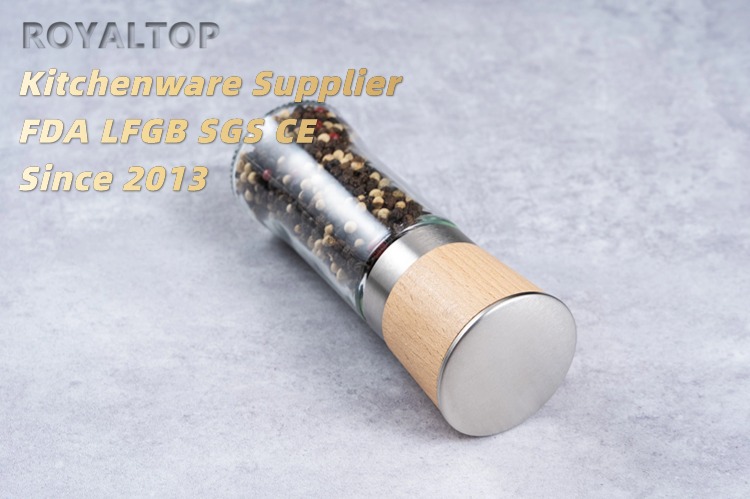
Royaltop as a supplier of home and kitchen products, we design and launch new products every year to meet our customers' needs and solve their troubles. This is an innovatively designed salt and pepper grinder with a unique and eye-catching look. This manual black pepper mill features a 140ml lead-free glass spice bottle, beech wood grinding cap, stainless steel dust cap and adjustable ceramic rotor.
We fully understand the needs of our customers and have done a lot of market research, after repeated trials and continuous testing, we finally launched this salt and pepper mill bottle. It is not only innovative in design but also durable and easy to clean, suitable for grinding sea salt, Himalayan salt, black pepper and other spices. The spice bottle can hold approximately 70g of pepper or 100g of salt, and its straighter body greatly increases the range of labels that can be stuck on, which is good news for commercial customers.
This this kitchen spice bottle is now in the market testing session, so if you need a unique design, if you need a distinctive pepper mill bottle, please contact us as soon as possible.
Designing a new salt and pepper mill requires a combination of factors, from user needs, functionality to production process. Below are the main steps in designing a salt and pepper mill from Royaltop factory:
1. Market research and demand analysis
User needs: Understand customers' habits, preferences, and pain points for salt and pepper mills. For example, consumers may want products that are easier to clean, more durable, or more aesthetically pleasing. The right capacity not only controls the cost of the product but also allows the spices to be used up at the right time and without frequent refilling.
Competitive analysis: Study the grinder designs already on the market, identify the strengths and weaknesses of competitor products, and determine the direction of design differentiation. We all don't want our kitchen and dining table to be featureless and uniform, and a novel spice tool can embellish it.
2. Conceptual design
Functional design: determine the basic functions of the grinder, such as grinding coarseness adjustment, ease of use, moisture-proof design. A good spice grinder bottle should also have adjustable function, no matter cooking, salad or barbecue can use it.
Appearance design: According to the results of market research, design the appearance and shape of the product, taking into account the beauty of the product, the feel and the brand style.
Material selection: Choose the right material, such as plastic, metal, wood or glass, taking into account the durability, cost and visual effect of the product. The grinder used for holding food should moreover be made of high-quality materials that are odourless, non-toxic and do not contaminate the food.
3. Technical design
Grinding mechanism design: the core of the grinder is the grinding mechanism, the design team will choose or develop a suitable grinding mechanism, such as ceramic grinding core or stainless steel grinding core, to ensure that the grinding effect is consistent and not easy to damage.
Structural design: The internal structure of the grinder is designed to ensure that the parts fit together smoothly and are easy to use and maintain.
Prototyping: Produce a prototype of the product for testing and improvement to verify the feasibility of the design and user experience.
4. Testing and Verification
Functional testing: Test the grinding effect, durability, and comfort of the grinder to ensure that the product meets the design requirements.
Safety testing: Ensure that the product will not cause harm to the user during use, such as whether the edges are sharp and the materials are safe.
User feedback: Obtain user feedback through trials or focus groups to further optimise the design.
5. Production Design
Production process design: According to the product design, formulate the production process, including mould design, production line layout, quality control, etc.
Cost control: optimise the production process and reduce the production cost under the premise of ensuring product quality.
6. Mass production and market launch
Mass production preparation: adjust the production line for mass production to ensure that each product can meet the quality standards.
Packaging design: Design the packaging of the products, taking into account transport safety, brand image and consumers' out-of-the-box experience.
Marketing: Develop a marketing strategy to promote the product to the market through advertising, social media and sales channels.
Through these steps, the factory was able to go from concept to finished product and design a salt and pepper grinder that meets the market demand.
 100ml Custom Glass Oil Sprayer – Ultimate OEM Cooking Oil Dispenser for Wholesale Brands
 20+ Years Spice Grinder Factory | Urgent Order Shipped Ahead Schedule for European Partner
 Leading Spice Packaging Manufacturer Royaltop Successfully Ships Premium Containers to World-Class American Spice Brand Supplying Walmart
 Royaltop's Perfect Spice Packaging Solutions


