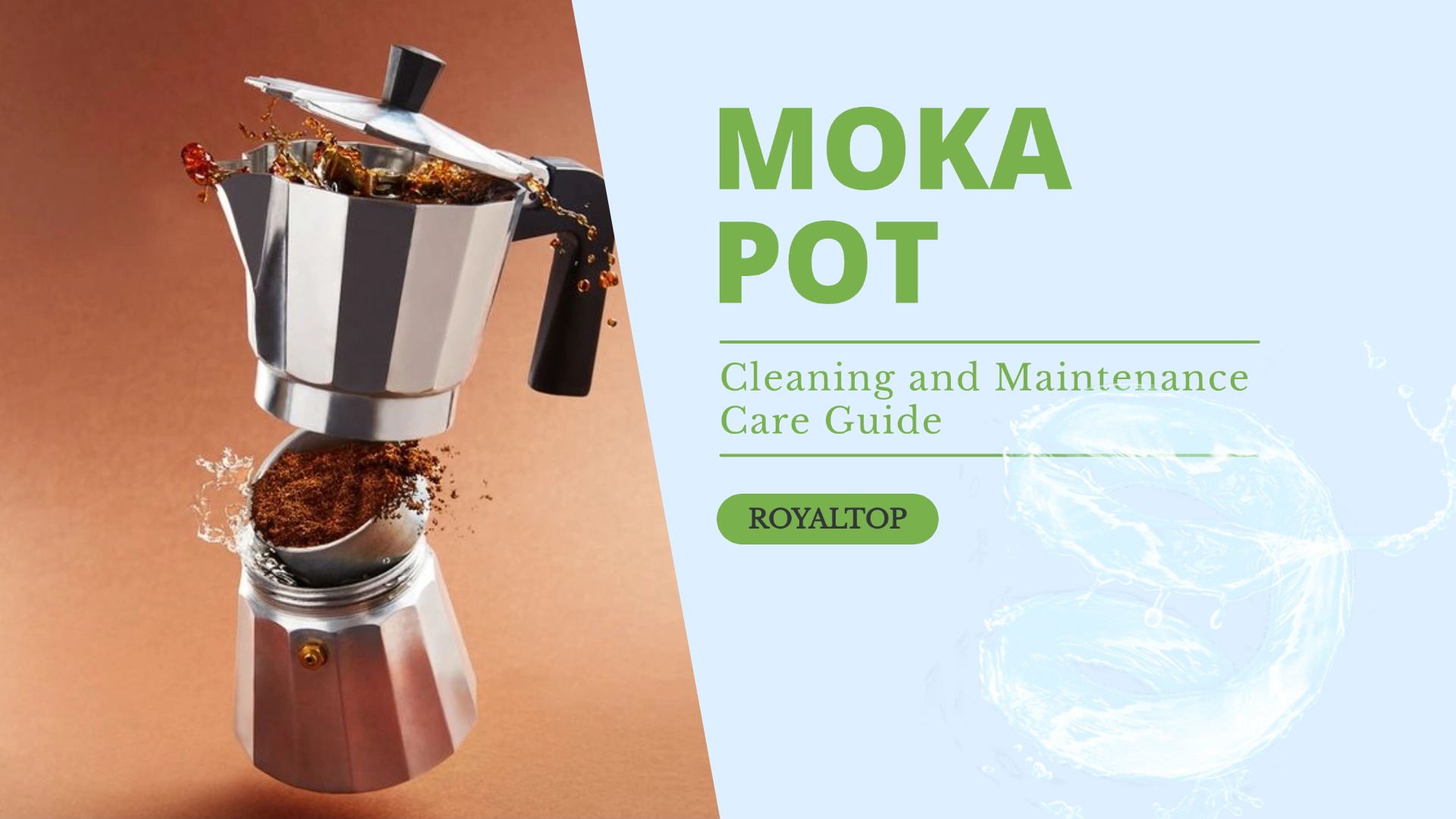
Cleaning and maintaining your stainless steel moka pot is key to extending its lifespan and ensuring the purity of your coffee's flavour. Royaltop consulted with several moka pot enthusiasts and compiled a list of cleaning tips. Below is a professional maintenance guide for stainless steel pots, covering daily cleaning, deep maintenance, and safety precautions:
A. Daily cleaning steps (after each use)
1. Cooling and disassembly
- Safe operation: After extraction, let it sit for at least 3 minutes → Wrap the lower pot in a wet cloth and unscrew it (to prevent burns)
- Scientific principle: Sudden exposure of a hot pot to cold water can cause metal deformation (especially composite bottom pots)
2. Cleaning of individual parts
| Component |
Cleaning method |
Taboo |
| Coffee powder container |
Rinse with cold water → Gently brush the filter screen with a soft brush |
Disable hot water (to solidify coffee grounds) |
| Upper and lower pots |
Neutral detergent + sponge scrub |
Do not use steel wool pads (scratches the surface) |
| Silicone seal |
Rinse with warm water → Rub the grooves with your fingertips |
Avoid alcohol (accelerates ageing) |
> Stain removal tip: Apply baking soda paste (baking soda:water = 3:1) to the coffee stain → Leave for 5 minutes → Wipe clean easily
B. Deep maintenance cycle (monthly/quarterly)
1. Descaling process (essential!)
1). Disassemble the kettle body → Fill the lower kettle with water up to the safety line
2). Add white vinegar:water = 1:4 or citric acid solution (10g/500ml)
3). Heat over low heat until steam escapes from the spout → Turn off the heat and let it sit for 30 minutes
4). Drain the solution → Boil twice with clean water to remove residual acid
> Harmful effects of scale: 1 mm of scale reduces heat transfer efficiency by 21% → prolongs heating time + causes a bitter taste
2. Pressure relief valve maintenance
- Test method:
Clean the valve hole with a cotton swab dipped in alcohol → Blow air into the valve to check if it is unobstructed (airflow should be smooth)
- Signs of failure: No hissing sound when heating → Stop using immediately and replace
3. Activation of sealing rings
- Soak silicone rings in food-grade glycerine for 10 minutes → Restore elasticity (extend service life by 2 times)
C. Key points for material-specific maintenance
1. Preventing surface scratches
- Cleaning tools: Microfibre cloth > Sponge > Scouring pad (in order of increasing hardness)
- Storage principles: Store upside down or separately (to avoid friction between components)
2. Mirror polishing of the kettle body
Materials: Food-grade stainless steel polish + eyeglass cloth
Technique: Wipe in circles along the metal grain → Use toothpaste to remove stubborn oxidation layers
3. Thread protection
- Apply food-grade mineral oil to the threads every month → to prevent rust and jamming (do not use vegetable oil!)
D. Error operation warning table
| Misconduct |
Consequences |
Correct alternative |
| Pour cold water into a hot kettle |
Deformation of the bottom of the pot/cracking of the threads |
Allow to cool naturally to below 60°C before cleaning |
| Dishwasher cleaning |
Seal ring ageing accelerated by 3 times |
Always hand wash |
| Soak for more than 2 hours |
Risk of metal ion precipitation |
Complete cleaning within 30 minutes |
| Drying machine drying |
High temperatures destroy the molecular structure of sealing rings |
Turn upside down and dry in a well-ventilated place |
E. Component replacement cycle and selection
| Component |
Replacement cycle |
Selecting criteria |
| Sealing ring |
1~2 years |
Food-grade silicone (temperature resistance > 200°C) |
| Filter screen |
More than 5 years |
304/316 stainless steel, laser perforated |
| Pressure relief valve |
Lifetime replacement |
Regularly test for smoothness |
> Self-inspection tips:
> Judging whether the seal ring has aged → If white cracks appear after stretching (loss of elasticity), it needs to be replaced.
F. Storage guidelines
1. Completely dry: Use kitchen paper to absorb moisture from the threaded gaps.
2. Separate storage: Place the upper pot upside down on the lower pot (with the sealing ring suspended to prevent crushing).
3. Environmental requirements: Avoid light and moisture (humidity < 60%), and keep away from acidic gases (such as vinegar jars).
A stainless steel moka pot is a lifelong companion—with proper maintenance, it can last for more than 15 years. Each time you maintain it, you are infusing the next cup of coffee with soul. This careful care will ultimately be rewarded with the rich aroma that lingers on your lips and teeth.
BLOG OUTLINE:
 100ml Custom Glass Oil Sprayer – Ultimate OEM Cooking Oil Dispenser for Wholesale Brands
 20+ Years Spice Grinder Factory | Urgent Order Shipped Ahead Schedule for European Partner
 Leading Spice Packaging Manufacturer Royaltop Successfully Ships Premium Containers to World-Class American Spice Brand Supplying Walmart
 Royaltop's Perfect Spice Packaging Solutions


